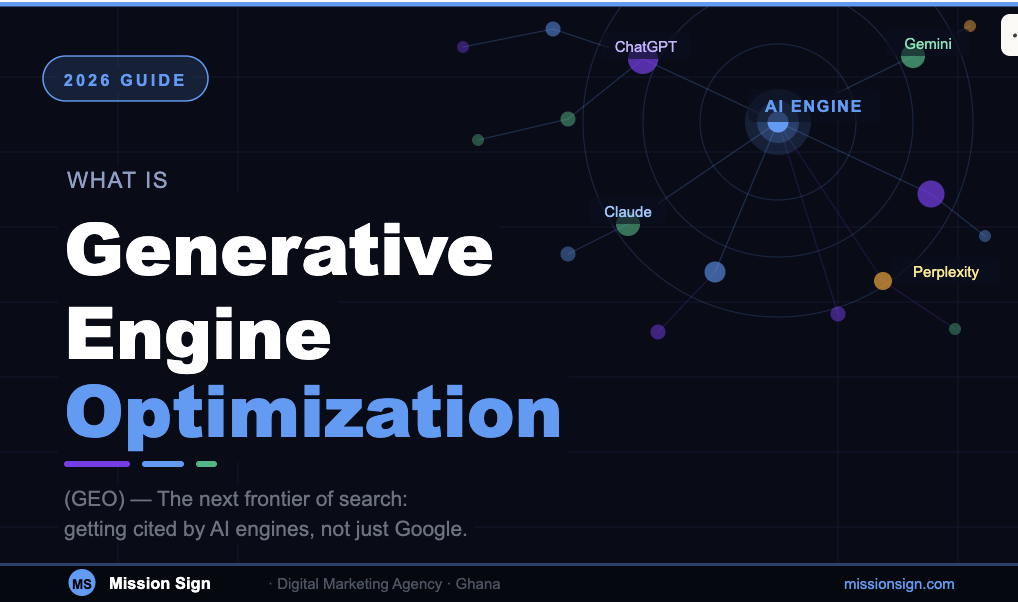
Generative Engine Optimization (GEO) is a term used to describe efforts to make information about a business, organization, product or topic easier for AI-powered search and answer systems to understand, retrieve and reference.
As search increasingly includes AI-generated answers, businesses are paying more attention to how their information is represented across search engines and AI-powered platforms.
But GEO should not be treated as a replacement for search engine optimization (SEO), nor should businesses expect a particular tactic to guarantee that ChatGPT, Google AI Overviews, Gemini or another AI system will mention their company.
For most businesses, the practical approach is to create useful, trustworthy and well-structured information that can be discovered and understood by both traditional search engines and newer AI-powered search experiences.
What Is Generative Engine Optimization?
Generative Engine Optimization, commonly abbreviated as GEO, is a broad term for improving the way a website and its information can be understood and surfaced by generative AI-powered search and answer systems.
Traditional search engines generally return a list of links in response to a query.
Generative search systems can instead produce an answer using information gathered from multiple sources and may provide links or citations to supporting webpages.
This creates a slightly different visibility question for businesses:
Can search and AI systems find, understand and accurately represent information about my business?
GEO is concerned with that broader question.
However, there is no single universally accepted technical standard called “GEO,” and there is no guaranteed formula for making an AI system mention a particular business.
GEO vs SEO: What’s the Difference?
SEO and GEO overlap considerably.
Search engines still provide much of the information used by modern search experiences, and Google’s current documentation specifically states that its existing SEO best practices remain relevant to AI features such as AI Overviews and AI Mode.
The difference is primarily in the way users receive information.
Traditional search
A user might search:
digital marketing agency in Accra
Google may return:
- Agency websites
- Business profiles
- Directory listings
- Articles
- Reviews
- Other relevant resources
The user then chooses which result to visit.
Generative search
A user might instead ask:
Which digital marketing agencies in Accra specialize in SEO?
An AI-powered search system may synthesize information from several sources and provide an answer accompanied by links or citations.
That means businesses need to think about both:
Ranking for relevant searches
and
Being represented accurately when search systems summarize information.
These are related objectives, not completely separate disciplines.
Why Are Businesses Talking About GEO in 2026?
Search behavior is changing.
Google now provides AI-generated search experiences, while services such as ChatGPT can search the web and provide links to sources. OpenAI says any public website can potentially appear in ChatGPT Search, provided it is accessible to the relevant search crawler; however, placement is not guaranteed.
This creates another opportunity for businesses to make their information clear and accessible online.
For example, a potential customer might ask an AI-powered search system:
“What are the best restaurants in Accra for a business lunch?”
Or:
“Which accounting firms in Ghana specialize in SMEs?”
Or:
“Which digital marketing companies in Ghana offer SEO?”
The system needs information from somewhere to construct its response.
Businesses therefore benefit from having accurate, consistent and useful information available across the web.
How AI Search Can Understand a Business
AI-powered search systems can use information from websites and other online sources.
That information may include:
- Business names
- Services
- Locations
- Product information
- Organization descriptions
- Published articles
- Reviews
- Industry publications
- Business directories
- Structured data
- Other publicly available information
No single page necessarily determines what an AI system will say.
Instead, businesses should aim to establish a consistent and trustworthy online presence.
For a Ghanaian business, that may include making sure that its:
- Website
- Google Business Profile
- Social profiles
- Directory listings
- Company descriptions
- Contact information
- Service pages
- Published articles
are reasonably consistent.
1. Make Your Business Information Clear
One of the simplest things a business can do is explain clearly what it does.
Your website should make it easy to identify:
- The company’s name
- What it does
- Where it operates
- Who it serves
- Which products or services it provides
- How customers can contact it
For example, instead of writing:
“We help businesses transform their digital future.”
a clearer description might be:
“Mission Sign is a digital marketing agency in Accra, Ghana, providing SEO, content marketing, lead generation and digital strategy services.”
The second statement provides much more concrete information.
Clear writing helps people and machines understand the same thing.
2. Create Dedicated Service Pages
If your company provides several services, don’t hide everything on one generic “Services” page.
Consider creating useful pages for important services such as:
- SEO
- Local SEO
- Social media marketing
- Google Ads
- Content marketing
- Web development
- Lead generation
Each page should explain:
- What the service is
- Who needs it
- How it works
- What the business actually provides
- What outcomes can reasonably be expected
- Frequently asked questions
- Relevant examples or evidence
The goal should be to help the customer—not to create pages simply because each service has a keyword.
3. Publish Original Information
Original information can make a website more useful than a collection of generic explanations.
Examples include:
- Research
- Surveys
- Case studies
- First-hand observations
- Original data
- Expert interviews
- Industry analysis
- Detailed tutorials
- Documented experiments
For example, Mission Sign’s State of Digital Marketing in Ghana 2026 report is more useful as a research asset when its methodology, sample and limitations are clearly explained than if it is presented simply as another marketing article.
Original information gives other websites something useful to reference.
4. Build Evidence Beyond Your Own Website
A company describing itself as “the leading digital marketing agency in Ghana” is not the same as independent evidence showing that other organizations recognize or reference the company.
For businesses trying to establish credibility online, relevant third-party evidence can include:
- Industry publications
- Professional associations
- Interviews
- Conference appearances
- Awards
- Independent reviews
- Client references
- Academic or research publications
- Reputable business directories
The objective is not to manufacture mentions.
It is to make the company’s real-world identity and expertise easier to verify.
5. Keep Business Information Consistent
Suppose a company uses three different descriptions:
Website:
Digital marketing agency in Accra
Directory:
IT consulting company in Kumasi
Social profile:
Global business solutions provider
That inconsistency can make the business harder to understand.
Businesses should periodically check important information such as:
- Business name
- Address
- Telephone number
- Website
- Services
- Business description
- Opening hours
- Social profiles
This is particularly important for businesses serving local customers.
6. Strengthen Your Local Online Presence
For businesses serving customers in Ghana, local visibility remains important.
Depending on the business, this may include:
- Google Business Profile
- Accurate address information
- Local service pages
- Customer reviews
- Local business directories
- Location-specific content
- Clear contact information
A restaurant in Accra, for example, should make its location, opening hours, menu and contact information easy to understand.
A professional services company may need clear information about its office location and the areas it serves.
GEO does not replace local SEO.
7. Use Structured Data Where It Is Appropriate
Structured data can help search engines understand certain types of content.
Depending on the website, appropriate schema types may include:
- Organization
- LocalBusiness
- Product
- Article
- BreadcrumbList
- Event
- Person
Structured data should accurately describe information that is visible and supported on the page.
It should not be used to make unsupported claims about a business.
Schema markup is also not a guarantee that an AI system will mention a business.
8. Make Your Website Easy to Crawl
AI search visibility starts with accessibility.
If important pages cannot be crawled or accessed, search systems may have difficulty using the information.
Check:
- Robots.txt
- Noindex directives
- Canonical tags
- Server errors
- Broken links
- Website availability
- JavaScript-dependent content
- Authentication barriers
For ChatGPT Search specifically, OpenAI says publishers should avoid blocking OAI-SearchBot if they want their content to be available for discovery and citation in ChatGPT Search.
This is a technical SEO issue as much as an AI-search issue.
9. Write Answers to Real Customer Questions
One useful way to make a website more understandable is to answer questions customers actually ask.
For example, a Ghanaian accounting firm might publish:
How much does accounting software cost for a small business in Ghana?
A hotel might answer:
What is the best area to stay in Accra for a business trip?
A digital marketing agency might answer:
How much does SEO cost in Ghana?
Good question-based content should provide a genuine answer.
Avoid creating dozens of nearly identical pages simply by changing the wording of a keyword.
Google’s current spam guidance specifically warns against scaled content created primarily to manipulate search rankings rather than help users.
10. Demonstrate Experience
Businesses should not rely entirely on generic statements about expertise.
Show what you actually know.
For example:
Instead of:
We are experts in SEO.
Provide:
We audited a Ghanaian e-commerce website with 1,200 indexed URLs and identified duplicate title tags, weak category pages and internal-linking problems. After restructuring the category architecture, we monitored organic impressions and conversions over the following months.
Specific information is more useful than broad promotional language.
Where possible, include:
- Methodology
- Screenshots
- Data
- Examples
- Limitations
- Results
Only publish numbers that can be substantiated.
GEO Does Not Mean “Ranking in ChatGPT”
One of the biggest misconceptions about GEO is that there is a simple equivalent of Google’s ranking position.
There isn’t.
A business cannot reliably say:
“We are #1 in ChatGPT.”
AI-powered search systems can generate different answers depending on:
- The user’s question
- Location
- Context
- Search results
- Available sources
- Time
- The system being used
OpenAI states that ChatGPT Search uses multiple factors to rank search results and that placement is not guaranteed.
Therefore, businesses should be careful with agencies promising guaranteed AI citations or guaranteed placement in ChatGPT, Gemini or other generative systems.
Does GEO Replace SEO?
No.
For Google Search, Google’s current documentation explicitly says that SEO best practices remain relevant to its generative AI search experiences.
That means businesses should not abandon:
- Technical SEO
- Helpful content
- Internal linking
- Search intent
- Page experience
- Local SEO
- Structured data
- Crawlability
- Site architecture
Instead, think of AI-search visibility as another reason to make those fundamentals stronger.
GEO for Ghanaian Businesses: A Practical Example
Imagine a digital marketing agency in Accra.
It wants potential customers to find it when they search for:
SEO agency in Accra
or ask:
Which companies in Ghana provide SEO services?
A sensible strategy would include:
Website
Create a clear SEO service page explaining the service, target customers, process and evidence.
Local information
Clearly identify the agency’s location and service area.
Expertise
Publish useful SEO resources based on genuine experience.
Evidence
Publish documented case studies where client permission allows.
Third-party references
Build legitimate professional and industry relationships that may naturally lead to mentions.
Technical accessibility
Make sure important pages can be crawled and indexed.
Measurement
Monitor Google Search Console, analytics and relevant referral traffic.
None of these steps guarantees an AI citation.
Together, however, they create a much stronger digital presence.
How to Measure GEO
Measuring AI-search visibility is still developing.
Businesses can monitor several signals rather than relying on a single “GEO ranking.”
1. Search visibility
Monitor relevant Google queries through Search Console.
2. Referral traffic
Look for traffic coming from AI-powered services where the referring source is identifiable.
OpenAI says ChatGPT referrals can be tracked in analytics and use a utm_source=chatgpt.com parameter.
3. Brand mentions
Track legitimate mentions of your business across websites, publications and other online sources.
4. Conversion activity
Ultimately, measure whether visibility produces:
- Leads
- Calls
- Enquiries
- Sales
- Bookings
- Other meaningful business outcomes
A mention without a useful business outcome may have limited value.
Common GEO Mistakes to Avoid
Mistake 1: Creating hundreds of AI-generated pages
More pages do not automatically create more visibility.
Google’s spam policies warn against scaled content created primarily to manipulate search rankings rather than provide value.
Mistake 2: Repeating the same keywords
Writing:
best SEO agency Ghana
best SEO agency in Ghana
top SEO agency Ghana
leading SEO agency Ghana
throughout a page does not make the content more authoritative.
Write naturally for people.
Mistake 3: Making unsupported claims
Avoid:
- #1 in Ghana
- Guaranteed ChatGPT citations
- Guaranteed AI rankings
- 100% AI visibility
- Guaranteed Google rankings
unless you have a legitimate basis—and even then, avoid guarantees about systems you do not control.
Mistake 4: Creating fake third-party mentions
Do not manufacture reviews, fake profiles, fake awards or artificial references simply to make an AI system perceive a company as authoritative.
Mistake 5: Ignoring traditional SEO
AI search does not eliminate the need for a technically sound website and useful content.
A Practical GEO Checklist for Ghanaian Businesses
Use this checklist when reviewing your website.
Business information
- Company name is consistent
- Contact details are accurate
- Location is clearly stated
- Services are clearly explained
- About page identifies the business and team
Website
- Important pages are crawlable
- Important pages are indexable
- Internal links are logical
- Pages load properly
- Broken links are fixed
- Canonical tags are correct
Content
- Service pages answer real customer questions
- Articles provide original value
- Claims can be supported
- Case studies include evidence
- Content is written for people rather than search engines
Local visibility
- Google Business Profile is accurate
- Business information is consistent
- Reviews are genuine
- Location pages are useful
- Local service information is clear
AI-search accessibility
- Important content is accessible to relevant crawlers
- OAI-SearchBot is not unnecessarily blocked if ChatGPT Search visibility is desired
- Website content is clearly structured
- Organization information is easy to understand
- Important facts are consistent across trusted sources
Frequently Asked Questions
What is Generative Engine Optimization?
Generative Engine Optimization (GEO) is a broad term for improving how information about a website, business or organization can be discovered, understood and potentially surfaced by AI-powered search and answer systems.
Is GEO the same as SEO?
No. The concepts overlap substantially. SEO focuses on improving visibility in search engines, while GEO is generally used to describe visibility in generative AI-powered search and answer experiences. Google’s current guidance states that existing SEO best practices remain relevant to its generative AI search features.
Does GEO guarantee that my business will appear in ChatGPT?
No. ChatGPT Search uses multiple factors when ranking search results, and OpenAI states that placement is not guaranteed.
How can I make my website available to ChatGPT Search?
OpenAI says public websites can appear in ChatGPT Search and recommends allowing OAI-SearchBot to crawl the site if publishers want their content to be discoverable and potentially cited.
Does my business need GEO in 2026?
Businesses do not necessarily need a separate GEO programme. They should first have strong fundamentals: useful content, technical SEO, clear business information, good website accessibility and legitimate evidence of expertise. These practices can support visibility across both traditional and AI-powered search experiences.
How do I optimize my website for AI search?
Start with clear business information, useful original content, strong technical SEO, logical site structure, accurate local information, appropriate structured data and legitimate third-party references. Avoid tactics designed solely to manipulate AI systems
Does schema markup improve GEO?
Structured data can help search engines understand supported information about a page or entity, but it does not guarantee AI citations or rankings. Use schema accurately and only where it reflects the content on the page.
Can a small Ghanaian business benefit from GEO?
Yes. A small business can improve its online visibility by making its services, location, expertise, customer information and other important facts clear and consistent online. It does not need a large content operation to begin.
Final Thoughts
Generative AI is changing how people discover and consume information online, but businesses should avoid treating GEO as a shortcut to visibility.
The strongest approach is to make your business easier to understand, easier to verify and easier to discover.
That means investing in:
- Useful content
- Technical SEO
- Clear service information
- Local visibility
- Genuine expertise
- Original research and case studies
- Consistent business information
- Accessible websites
These fundamentals can support visibility across traditional search and newer AI-powered search experiences.
GEO should therefore be viewed as an evolving extension of digital visibility, rather than a replacement for SEO or a guaranteed method for getting mentioned by an AI system.
For Ghanaian businesses, the practical question is not simply:
“How do I rank in ChatGPT?”
It is:
“How do I build an online presence that search engines, AI systems and—most importantly—customers can understand and trust?”
That is the foundation of sustainable search visibility.
Editorial Note
This article is intended as an educational guide. AI-powered search systems change frequently, and their ranking, retrieval and citation processes are not fully controllable by website owners.
Mission Sign provides digital marketing and search-visibility services, including SEO and work related to emerging AI-search experiences. References to GEO in this article should not be interpreted as a guarantee of placement, citation or recommendation by any particular AI system.
Frequently Asked Questions
- What does GEO mean in digital marketing?
GEO stands for Generative Engine Optimization. It involves optimizing content for AI-powered search engines and generative AI systems. - Why is GEO important for Ghana businesses?
GEO helps businesses increase visibility, improve authority, generate leads, and stay competitive as AI search grows.
Quick Summary
Generative Engine Optimization (GEO) is the process of optimizing digital content so that AI-powered search engines and generative AI systems can easily understand, trust, and recommend your business in their responses. Unlike traditional SEO, which focuses mainly on ranking websites on Google search pages, Generative Engine Optimization (GEO) focuses on helping AI engines reference your business directly when users ask conversational questions.