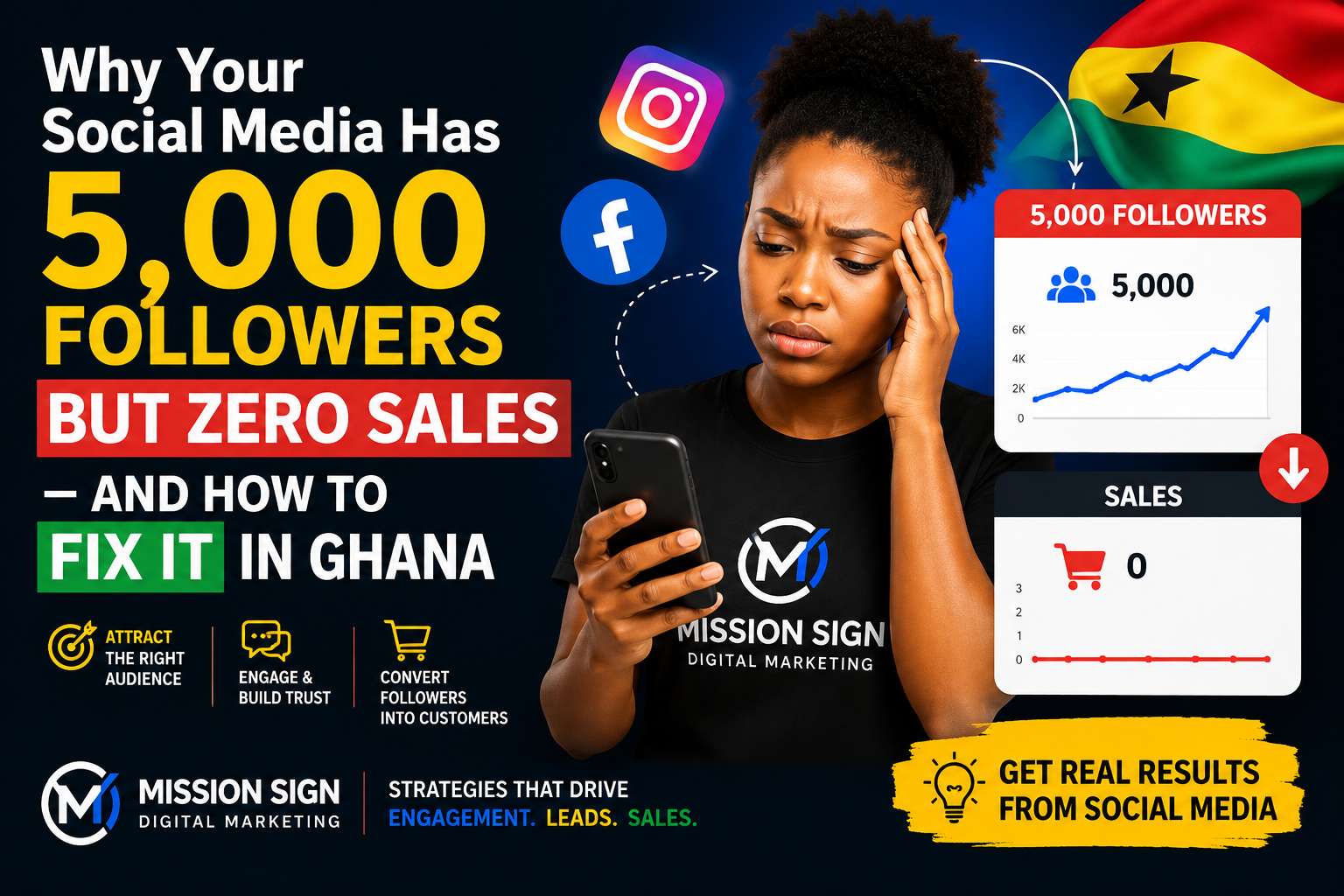
You post every day. Your page looks professional. Your followers are growing. People like your content, comment fire emojis, and share your posts.
But when you check your sales at the end of the month — nothing has changed.
If this sounds familiar, you are not failing at social media. You are succeeding at the wrong game.
There is a critical difference between a social media account that entertains and an account that sells. Most Ghanaian businesses are building the first one while hoping for results from the second. The gap between your follower count and your revenue is not a mystery — it is a strategy problem with a clear, fixable solution.
According to Mission Sign’s 2026 State of Digital Marketing in Ghana report, 52% of Ghanaian business owners identify low social media engagement as a major challenge, and 71% struggle with customer acquisition and lead generation. These two problems are deeply connected — and this guide addresses both of them head-on.
Here is exactly why your social media is not generating sales in Ghana, and precisely what to change to turn your followers into paying customers.
Reason 1 — You Are Building an Audience, Not a Customer Pipeline
This is the most common and most damaging mistake Ghanaian businesses make on social media.
There is a fundamental difference between an audience and a customer pipeline. An audience consumes your content. A customer pipeline moves people toward a buying decision. Most social media content in Ghana — beautiful product photos, motivational quotes, “good morning” posts, trending audio reels — builds an audience. Almost none of it builds a customer pipeline.
Building an audience feels productive because the metrics are visible and encouraging. Likes go up. Followers increase. Reach grows. But these numbers do not have a direct relationship with revenue unless you deliberately connect them to a buying action.
Think about the last ten posts on your business Instagram or Facebook page. How many of them contained a clear, specific call-to-action that asked followers to take a step toward buying? Not “contact us for more info” at the bottom of every post — but a specific, compelling, time-relevant invitation to take a next step?
If the answer is fewer than three, your content calendar is entertainment, not marketing.
The fix: Every piece of social media content should serve one of three purposes: attract new followers, build trust with existing followers, or move followers toward a purchase decision. At Mission Sign, we recommend a content ratio of 50% trust-building content, 30% value and education content, and 20% direct sales and offer content. The sales content is what converts — but the trust and value content is what makes the sales content credible when it appears.
Reason 2 — Your Call-to-Action Is Too Vague
“Contact us for more information.” “DM us to order.” “Call for pricing.”
These are the most common calls-to-action on Ghanaian business social media pages — and they are conversion killers. Not because they are wrong, but because they require the customer to do too much work.
Think about the psychology of a Ghanaian social media user scrolling through their feed. They stop at your post for three seconds. They are mildly interested. Then you ask them to “DM for more info” — which means they have to switch from passive consumption to active effort, compose a message, wait for a reply, and navigate a conversation before they even know the price. At every one of those steps, friction reduces the likelihood they follow through.
The research is clear: the more steps between interest and purchase, the lower the conversion rate. Every additional click, question, or decision your customer has to make before buying costs you sales.
The fix: Make your call-to-action as specific and frictionless as possible. Instead of “DM for pricing,” post the price directly in the caption. Instead of “contact us for more info,” include the key information in the post itself and direct followers to a specific link that takes them exactly where they need to go. Instead of “call us,” provide the WhatsApp number with a direct link that opens a pre-filled message.
The goal is to reduce the distance between “I am interested” and “I have bought” to as few steps as possible. In the Ghanaian market, where mobile money makes payment instant and easy, the biggest barrier is almost always information and friction — not payment capability.
Reason 3 — You Are Targeting Everyone and Converting Nobody
One of the most expensive mistakes on social media in Ghana is creating content for everyone. When your content tries to appeal to every possible customer — young and old, male and female, Accra and Kumasi, budget and premium — it ends up resonating deeply with nobody.
The businesses generating consistent sales from social media in Ghana are the ones that know exactly who their ideal customer is and create content specifically for that person. They know their customer’s age, location, income level, specific problem, and what language resonates with them. Their content feels personally relevant to that customer — which is why it converts.
A catering business in Accra that creates content specifically for corporate HR managers planning staff events will convert far better than one that creates generic food content for “anyone who likes good food.” The audience is smaller but the intent is higher and the conversion is dramatically better.
The fix: Define your ideal customer profile with ruthless specificity. Answer these questions in writing: Who is the one person most likely to buy from me? How old are they? Where in Ghana do they live? What is their income level? What specific problem does my product or service solve for them? What language do they use when describing this problem? What do they care about beyond my product?
Once you have this profile, every piece of content you create should be written, designed, and presented specifically for this person. Your follower count may grow more slowly. But the followers you gain will be buyers — not passive observers.
Reason 4 — You Have No Strategy for Moving Followers Down the Sales Funnel
Social media sales do not usually happen in a single post. Especially for higher-value products and services in Ghana — real estate, professional services, premium consumer goods — the buying journey involves multiple touchpoints over days or weeks before a customer commits.
Most Ghanaian businesses treat every social media post as a standalone event. Post today. Hope for sales. Post tomorrow. Hope for sales. There is no intentional sequence, no deliberate progression, no strategy for moving a follower from discovering your page to trusting your brand to eventually buying.
A social media sales funnel is simply a planned sequence of content that guides a potential customer through stages of awareness, interest, consideration, and purchase. Each stage requires different content:
Awareness content introduces your business and reaches people who have never heard of you. Short videos, trending audio, visually striking posts, educational content about problems your product solves. The goal is to stop the scroll and get a follow.
Interest content builds on initial awareness by going deeper. Customer testimonials, behind-the-scenes content, product demonstrations, founder stories, case studies. The goal is to build enough trust that the follower thinks: “This business seems legitimate and their product seems worth considering.”
Consideration content speaks directly to purchase barriers. Price transparency posts, comparison content, FAQ posts that answer the questions people ask before buying, limited-time offers, social proof from recognisable customers or clients. The goal is to address every reason the follower might have to hesitate.
Purchase content makes buying as easy as possible. Direct offers with clear pricing, simple payment instructions (MoMo number, bank details, payment link), delivery information, and strong urgency signals like limited availability or time-bound offers.
The fix: Map your content calendar to this funnel. Not every post needs to be a sales post — but your content plan should consciously include all four stages in proportion to your business needs. If your primary challenge is awareness, weight your content toward the top of the funnel. If you have strong awareness but low conversion, invest more in consideration and purchase content.
Reason 5 — You Are on the Wrong Platform for Your Customer
This is a hard truth that many Ghanaian business owners resist because they have invested significant time building a presence on a particular platform.
Not every platform is right for every business in Ghana. The platforms where Ghanaian consumers spend the most time are not necessarily the platforms where Ghanaian consumers make buying decisions. And the platform that works brilliantly for a fashion brand in Accra may be completely ineffective for a B2B services company targeting corporate clients.
Here is a practical guide to platform-business fit in the Ghanaian market in 2026:
Facebook remains the largest platform by user volume in Ghana with over 10 million users. It works well for: community building, local service businesses, event promotion, older demographic targeting (30+), and businesses where long-form posts and video content perform. Facebook Groups are particularly powerful for building customer communities in Ghana.
Instagram works best for visually driven businesses: fashion, beauty, food and beverage, real estate, interior design, events, and lifestyle brands. Instagram Reels currently deliver the highest organic reach of any content format on the platform in Ghana.
TikTok is emerging rapidly among Ghana’s younger demographics (18-30) and is particularly effective for awareness-stage content, personality-driven brands, and businesses whose products or services lend themselves to short, entertaining demonstration videos. Real estate tours, food preparation videos, and before-and-after transformations perform especially well on TikTok in Ghana.
LinkedIn is the most effective platform for B2B businesses — professional services, corporate training, technology, consulting, financial services — targeting decision-makers at Ghanaian companies, multinationals operating in Ghana, and diaspora investors. LinkedIn posts generate the highest quality leads of any social platform in the B2B space.
WhatsApp is the highest conversion platform for businesses that already have a warm audience. It is not a discoverability tool — it is a conversion and retention tool. Once customers know you, WhatsApp is where relationships deepen and repeat purchases happen.
The fix: Identify where your ideal customer spends their time and make that your primary platform focus. Maintain a presence on secondary platforms but invest your primary time and budget where your specific customer is most active and most likely to buy.
Reason 6 — You Have No System for Converting Comments and DMs Into Sales
Here is a scenario that plays out for hundreds of Ghanaian businesses every week:
A customer comments “How much?” on your product post. You reply in the comments with the price. The customer says “okay” or simply likes the comment — and never buys. The conversation ends. The sale is lost.
Or a customer sends a DM asking for more information. You respond. They go quiet. You move on to the next message. No follow-up. No conversion.
The problem is not the customer’s interest. It was real — they reached out. The problem is the absence of a conversion system. Interest without a follow-up process is just interest — it rarely becomes a sale on its own.
The fix: Build a simple DM and comment conversion process:
When someone comments asking for a price or more information, reply in the comments AND send them a direct message. In the DM, greet them by name, reference what they asked about, provide the full information clearly (price, delivery options, payment methods), and ask a simple closing question: “Would you like to place an order today? I can arrange delivery to [area].”
When a customer goes quiet after a conversation, follow up once — and only once — 24 to 48 hours later with a brief, non-pushy message: “Hi [Name], just following up on the [product] you asked about. Let me know if you have any questions or would like to go ahead.”
This single follow-up step recovers a significant percentage of lost sales at essentially zero cost. Most Ghanaian businesses never do it.
Reason 7 — You Are Not Using Paid Promotion Strategically
Organic reach on Facebook and Instagram in Ghana has declined significantly over the past three years. The platforms have become pay-to-play for reach beyond your existing followers. If you are relying entirely on organic posting to drive sales, you are operating with a significant structural disadvantage.
However, paid promotion done incorrectly — simply “boosting” posts to a vague audience — wastes money without generating proportional sales. The Ghanaian businesses that generate strong ROI from paid social promotion follow specific principles:
Promote your highest-converting content, not your most popular content. A post with 200 likes but zero sales conversations is not worth promoting. A post with 30 likes but 10 DM enquiries is worth promoting heavily.
Target with specificity. Use Facebook and Instagram’s targeting tools to reach people in specific locations in Ghana (Accra, East Legon, Spintex, Tema, etc.), specific age ranges, specific interests, and specific behaviours. Broad targeting wastes budget on people who will never buy.
Use Click-to-WhatsApp ads. These ads send interested customers directly into a WhatsApp conversation with your business — bypassing the friction of a website visit entirely and moving the customer straight into your highest-converting channel.
A 30-Day Action Plan to Start Converting Followers Into Sales
Week 1 — Audit and define Review your last 30 posts. Identify which ones generated actual enquiries or sales conversations versus which generated only likes and comments. Define your ideal customer profile in writing. Identify your primary platform based on where your target customer is most active.
Week 2 — Fix your content strategy Redesign your content calendar using the 50-30-20 ratio. Write specific, frictionless calls-to-action for every promotional post. Add pricing directly into your product posts instead of asking people to DM for pricing.
Week 3 — Build your conversion process Set up a DM response script for your three most common enquiry types. Train yourself or your social media manager to follow up on every unanswered enquiry within 24 hours. Set up WhatsApp Business auto-replies to capture enquiries outside business hours.
Week 4 — Test paid promotion Run one Click-to-WhatsApp ad targeted specifically at your ideal customer demographic in your primary service area. Start with a small budget — GHS 50 to GHS 100 — and measure the cost per WhatsApp conversation initiated. Scale the budget on the ad variant that generates the lowest cost per conversation.
Conclusion
Social media followers are not sales. They are potential sales — and the gap between potential and actual is filled by strategy, not by posting more content.
The businesses in Ghana generating consistent revenue from social media are not necessarily the ones with the most followers or the most creative content. They are the ones with a clear ideal customer, a deliberate content funnel, a friction-free buying process, and a systematic approach to converting interest into action.
Your 5,000 followers are not the problem. They are the opportunity. With the right strategy, a significant number of them can become paying customers — and paying customers become the loyal, returning, referring foundation of a business that grows predictably.
Stop posting for likes. Start posting for sales.
About the Author Shadrack Owusu Diamond is the CEO of Mission Sign Digital Marketing Agency, based in East Legon, Accra, Ghana. With 15+ years of experience managing 1,211+ digital marketing campaigns, he helps Ghanaian businesses convert their online presence into measurable revenue through SEO, GEO, social media management, and performance digital marketing.
Contact: info@missionsign.com | 024 827 2218 | missionsign.com